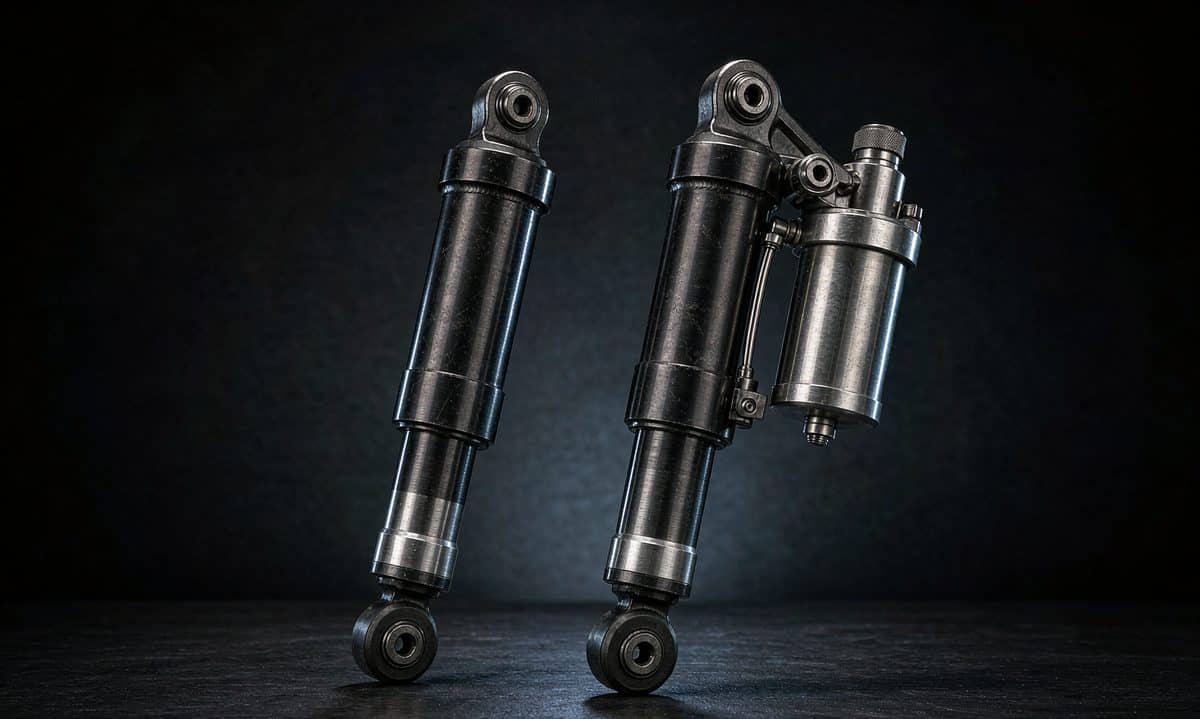
Emulsión vs depósito piggyback: qué cambia realmente en el trail
Every gas-charged shock has oil for damping and gas for pressure. The engineering question is whether those two are allowed to touch. That single design choice separates emulsion shocks from piggyback-reservoir shocks, and it explains most of the price and performance difference between them.
Emulsion shocks: simple and honest
In an emulsion shock, oil and gas share one chamber and mix under motion — the oil becomes aerated, like a shaken bottle. Consequences:
- Damping softens as the ride gets rough, because foamy oil compresses more easily.
- They are sensitive to sustained hard use: a fast fire-road descent that would take a piggyback shock in stride will visibly fade an emulsion unit.
- They are cheaper to build, lighter, and entirely adequate for commuting, light trail work and riders under ~75 kg riding at moderate pace.
An emulsion shock ridden within its envelope is a good product at a fair price. The failures we see are almost always envelope violations, not build quality.
Piggyback shocks: separation as a feature
A piggyback reservoir adds a second chamber, connected by a port, with a floating piston or bladder separating gas from oil. The oil stays dense, so damping stays consistent as heat and motion build. You get:
- Consistent damping through long, fast descents and repeated hits.
- Room for real adjusters — rebound and compression circuits that do something measurable.
- Higher cost, more mass, and one more seal to eventually service.
Which one for which customer
| Rider profile | Recommendation |
|---|---|
| Daily commute, potholes, occasional gravel | Emulsion |
| Loaded touring, two-up riding | Piggyback (consistency under load) |
| Sustained off-road, desert or mountain trails | Piggyback with adjusters |
| Fleet bikes where service intervals are long | Emulsion (fewer seals, simpler service) |
One practical note for buyers: a cheap piggyback shock is worse than a good emulsion shock. The reservoir only earns its cost if the damping internals, seals and gas charge behind it are up to standard. Judge the manufacturer, not the feature list — a reservoir on a shock with a mediocre damper rod is decoration.