Leer el desgaste del disco: espesor, alabeo y rayado
Brake discs fail three ways, and each shows up differently. A five-minute measurement tells you which one you are dealing with — and whether the pad, the disc or the mounting is the actual culprit.
1. Thickness — the safety limit
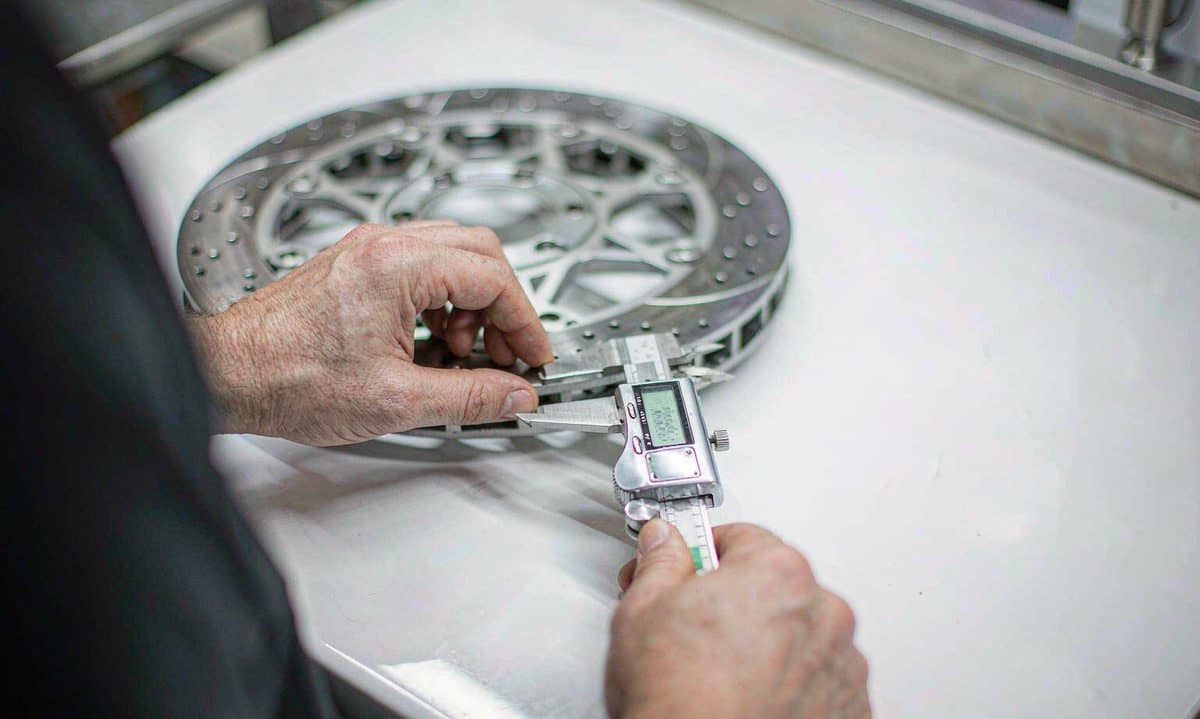
Every disc is stamped with a minimum thickness. Measure with a micrometer at 6–8 points around the rotor, offset from the wear track edges. Two things matter:
- Below minimum: replace, no discussion. Friction mass is part of heat capacity; a thin disc overheats and fades in exactly the situations you bought good pads to survive.
- Thickness variation >0.05–0.1mm across points: this is what causes pulsing, and it develops from localized heat (a parked hot brake) or uneven pad deposits. Varying thickness within spec but near the limit still warrants replacement if the customer complains of pulsing.
2. Runout — the vibration limit
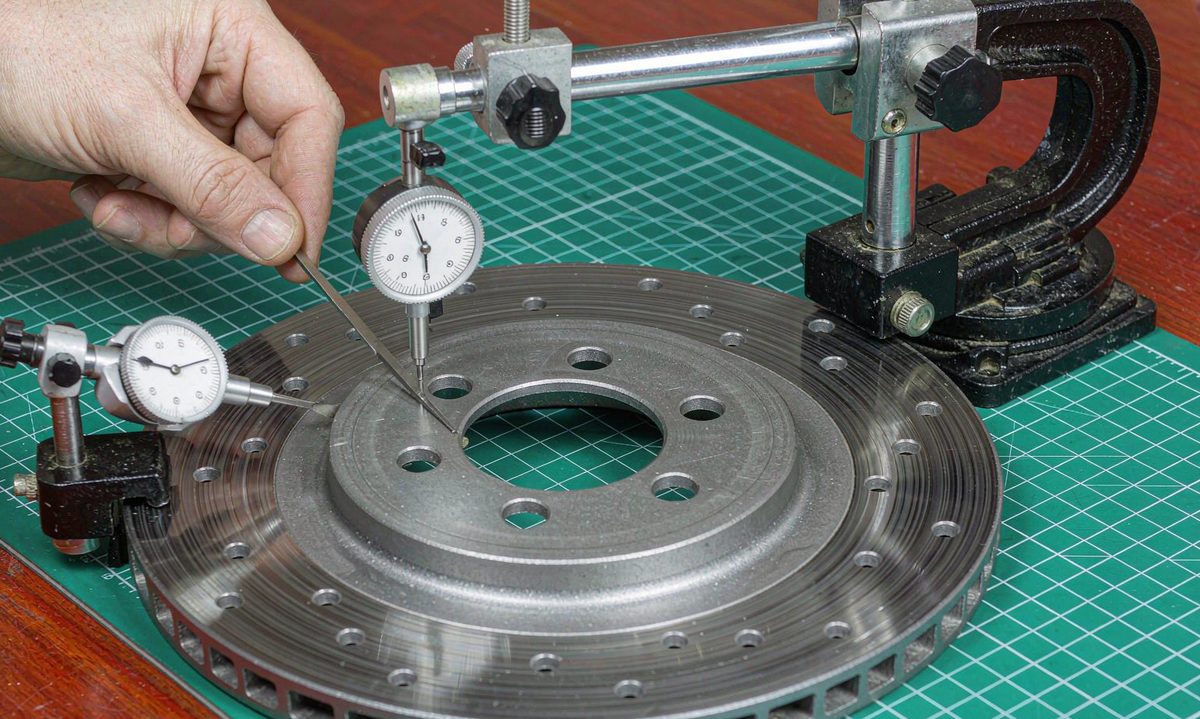
Mount a dial indicator on the fork leg or swingarm, tip against the disc face near the outer edge, and rotate the wheel. Acceptable runout is typically under 0.3mm; our own production limit is 0.15mm. Excess runout has two usual sources, and here is the trap: the disc may be fine. Check in this order: wheel torque (uneven axle pinch), hub face contamination, then the disc itself. A "warped disc" that is actually a dirty hub face is the classic misdiagnosis.
3. Scoring — the judgement call
Light concentric scoring is normal wear; the pad rides it. Deep grooves — catchable with a fingernail — have causes worth finding: a seized caliper pin dragging one pad, a trapped stone, or pad backplate contact. Beyond depth, the questions are: is the disc still above minimum thickness (measure at the bottom of the groove), and did the cause get fixed? A resurfaced disc with a dead caliper pin grooves again in 1,000 km.
Decision table
| Measurement | Finding | Action |
|---|---|---|
| Thickness below minimum | Any | Replace disc + pads |
| Thickness variation | >0.1mm | Replace or precision grind |
| Runout | >0.3mm | Check hub/torque, then disc |
| Scoring | Deep, new | Find cause, then measure thickness |
| Blue heat spots | Localized | Inspect riding style / caliper drag |
Always replace pads when replacing discs — old pads carry the old disc's wear pattern and will re-create it on the new rotor within days. It is the most common way a correct diagnosis gets wasted.