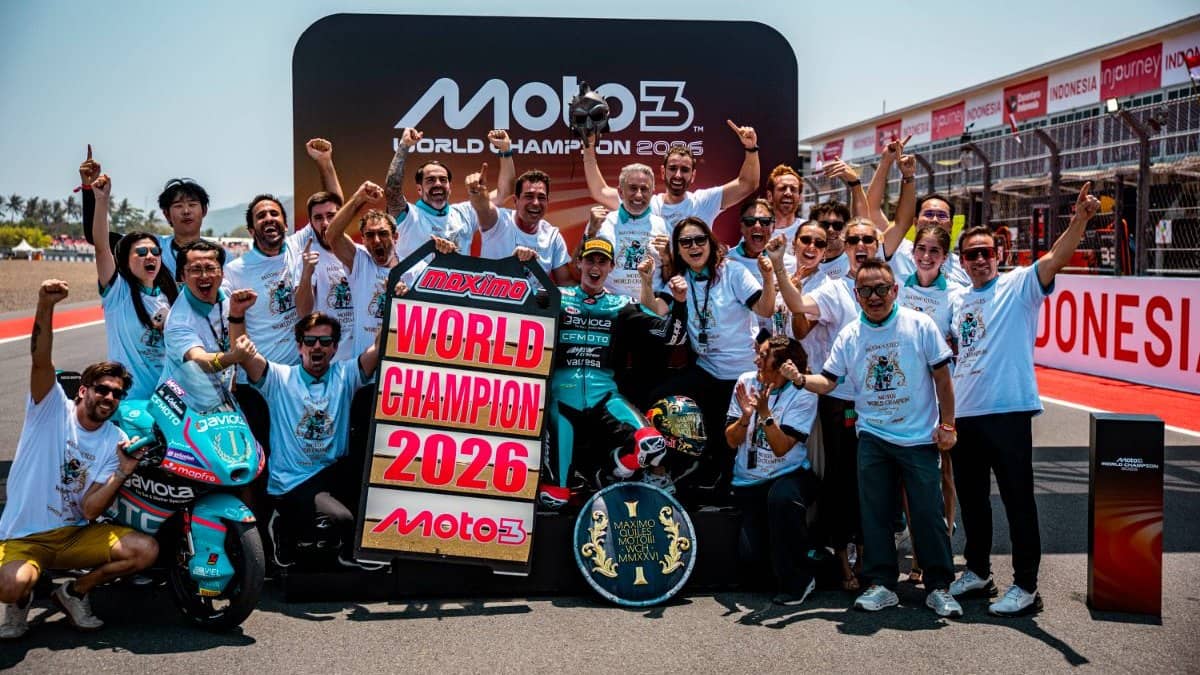
CFMOTO Wins the Moto3 World Championship Again — With Five Races Still to Run
On 11 October, at the Mandalika street circuit on the Indonesian island of Lombok, eighteen-year-old Maximo Quiles rode his CFMOTO Moto3 machine to victory in 32:36.820 and sealed the 2026 Moto3 World Championship with five rounds still to run. It was his tenth win of the season and his fifteenth podium from sixteen races — a win rate close to 60%.
That was enough to end the championship with a 133-point margin over David Almansa. It is the second Moto3 riders' title for CFMOTO's Aspar partnership, after David Alonso's crown in 2024, and it sets a new record for the earliest title clinch in the class. The asphalt at Mandalika reached close to 70 degrees Celsius that weekend, which makes the margin more impressive than the headline suggests: in that heat, tyre management decides races before talent does.
What the manufacturer has actually built
The story most industry readers skip is the timeline. CFMOTO entered Moto3 in 2022 as the only Chinese manufacturer on the grid. Two years later it swept the riders', teams' and manufacturers' championships in the class — the first Chinese brand to win a world championship in the MotoGP paddock and the first to win a Moto2 race. In 2025 it stepped back and rebuilt, with Quiles taking Rookie of the Year. In 2026 it won again, earlier than anyone.
That sequence is not a lucky rider meeting a lucky bike. It is three seasons of a factory learning how to run a European race team, and then repeating it. The partnership with Aspar has been extended to 2031 and covers both Moto2 and Moto3, which is the kind of commitment that only makes sense if the racing programme is feeding something else.
What it feeds is the product line. The company's own account of the programme is explicit: race-derived torque curves, frame stiffness data and electronic control algorithms go back into production bikes, with the V4 SR-RR and 500SR named as outputs. There is also a talent pipeline — a racing development scheme with seven contracted junior riders, and a thirteen-year-old Chinese rider, Sun Shengbo, who clinched the ESBK title in September 2026.
Why a Chinese championship matters commercially
The timing is worth noting. In the same month, another Chinese manufacturer finished second in the WorldSSP riders' championship and third among manufacturers — a result we covered separately. Two Chinese brands winning in two different world championships in one season is a different kind of signal from one good weekend.
For a distributor deciding where to source parts, the country of a race win is irrelevant. The country of the supply chain is not. What a Chinese factory winning in Moto3 changes is the burden of proof.
Ten years ago, a buyer in Lagos or Karachi asking for a Chinese-made clutch basket was taking a price decision and accepting a risk. Today the same buyer can point at a world championship, at a manufacturer that has won in Moto2 and Moto3, and at a supply chain that also ships the largest volume of small-displacement motorcycles in the world. The conversation shifts from "is it cheap" to "what is the specification". That shift is the single most important change in this business in a decade, and it is why our guide to MOQ, lead time and payment terms when importing from China gets read by buyers who already know the price.
It also raises the bar. A market that has watched a Chinese brand win at world level will not accept a part that fails at 3,000 km. The distributors who grow in the next cycle are the ones who can show a specification sheet, not just a quotation.
The specification lesson inside Moto3
Moto3 is a single-cylinder 250cc class with a spec ECU and a minimum weight — the closest thing in Grand Prix racing to a mass-production engineering problem. That is exactly why the class rewards the things a parts supplier cares about: friction control, thermal stability, fatigue life and consistent manufacturing tolerance rather than exotic materials.
Three components decide more Moto3 races than any engine upgrade: brake pads that hold their coefficient over twenty laps in 70-degree heat, a clutch that survives repeated race starts without glazing, and a chain and sprocket set that does not stretch. Those are the same three failure modes that fill a distributor's warranty claims on 125cc commuters. The engineering problems are the same problem at different scales.
Where the next two rounds matter
With the riders' title decided, the remaining interest is in the constructors' and teams' standings, and in whether Quiles' teammate Marco Morelli can climb to fourth overall. More importantly for 2027, the class will run alongside a MotoGP grid that switches to 850cc and Pirelli — a reset that redistributes technical advantage across the whole paddock, and one that a manufacturer with a winning Moto3 programme is better placed to exploit than one without.
The bottom line
A Chinese manufacturer has now won the Moto3 world championship twice, and the second time it did so with five races left and a 133-point margin. For anyone selling motorcycle parts into emerging markets, that result does not change what fits what. It changes what a buyer is willing to believe about a specification sheet — and that is worth more than any advertising budget. If you want to test that claim against a specific model rather than a brochure, start with the parts finder and check the fitment before the price.
Photo: CFMOTO — Maximo Quiles and the CFMOTO Aspar Team, Moto3 World Champions 2026, Mandalika.
التعليقات (0)
لا توجد تعليقات بعد. كن أول من يعلّق!