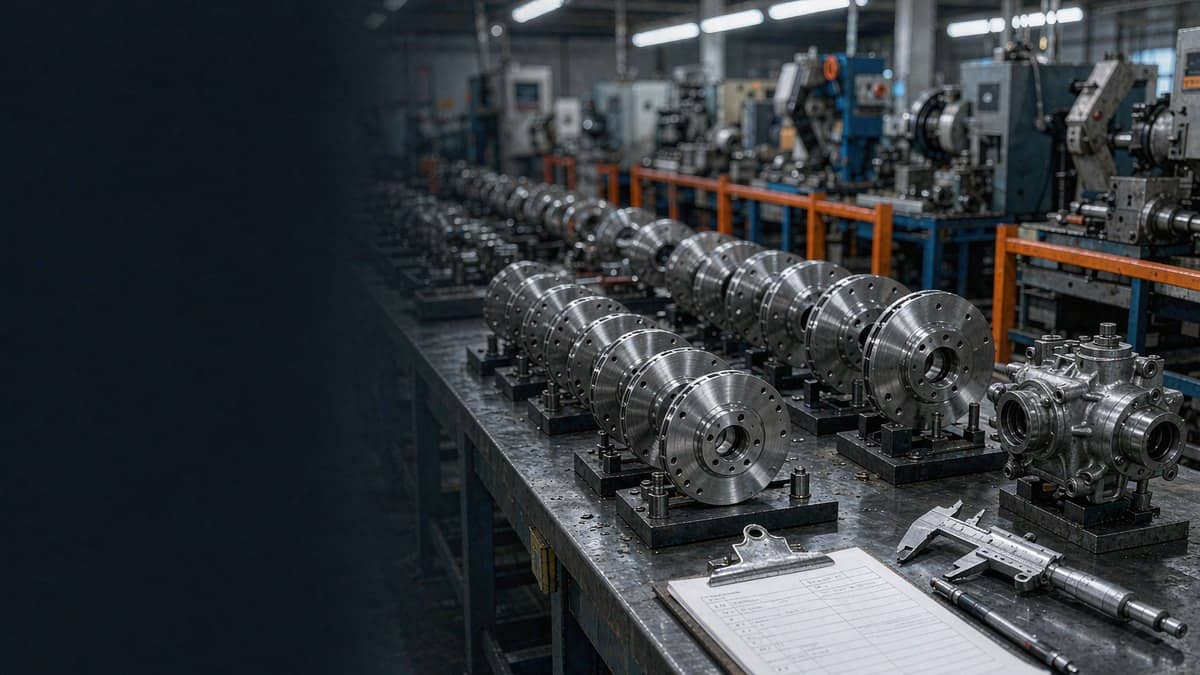
如何审查中国摩托车配件制造商:12 项核查清单
Choosing a manufacturing partner is the highest-leverage decision in the parts business: the right factory becomes an asset you build on for years, the wrong one costs you a season of customers. Marketplace profiles and salesmen's claims tell you almost nothing. This checklist covers the twelve checks that actually discriminate — ordered roughly the way you should run them, from desk verification to factory floor.
Desk Stage: Verify What Can Be Verified Remotely
1. Business License and Scope
Every Chinese company has an 18-digit Unified Social Credit Code on its business license. Check it on the national registry (or via SGS/Qima-style local agents) and read the registered business scope: a "manufacturer" whose scope lists only trading cannot legally run the production line it claims. Note the registration capital and the incorporation date — a factory born last year has no production track record to audit.
2. ISO 9001 — Verify the Certificate, Not the Logo
Forged and expired ISO certificates circulate freely. Every legitimate certificate carries a certifying body and a number; check it against the certification body's own register or the IAF CertSearch database. Two details matter more than the logo: the scope statement (does it cover motorcycle parts manufacture, or something generic?) and the certificate's issue-versus-expiry dates.
3. Product Certificates — ECE R90 and Beyond
For brake pads and discs destined for markets that enforce them, ask for the ECE R90 approval number and verify it in the UNECE approval database. A factory that holds genuine R90 approvals has already passed sample testing and production-conformity audits — it is the single strongest quality signal in the braking category. For non-brake categories, ask which destination-market standards their products meet and how conformity is tested.
4. OEM References and Export History
Ask which brands or assembly plants they supply, and in which markets they already ship at volume. An OEM or licensed-brand reference you can verify (even indirectly — via the brand's authorized parts network) outweighs any certificate. Export history to markets with demanding buyers (EU, Japan) implies the factory survives documentation, conformity and claim discipline.
Remote Audit Stage: See the Operation Before You Fly5. Production Equipment — Request the Actual Line, Not the Brochure
Ask for a live video walkthrough naming equipment as it appears: die-casting or gravity casting for housings, CNC machining cells, heat treatment (or its absence), assembly and test stations. The point is not the machine list — it is whether the video matches the layout, staffing and activity level of a working factory. Hesitation, reused footage and refusal to show specific processes are all data.
6. Which Processes Are In-House vs Outsourced
Most "manufacturers" outsource something — friction material mixing, heat treatment, anodizing. Outsourcing is legitimate and often optimal, but you must know where your quality is actually being controlled, because your claim process runs through whoever owns that step. Ask directly, then verify: casting marks, machining marks and packaging tell you more than the answer does.
7. QC System: Three Gates, Written and Staffed
Ask them to show you, not describe: incoming inspection records for friction material and castings, in-process checkpoints on the line, and final inspection with a stated AQL sampling plan. A factory that cannot produce a filled-in inspection record from last week does not have a QC system; it has a QC slogan.
8. In-House Testing Capability
What can they measure? For braking: friction coefficient testing across temperature, shear strength of pad backings, hardness and flatness of discs. For suspension: seal durability and damping curves. For carburetors: flow bench and altitude-variation testing. A laboratory is expensive — its presence (with recent calibration stickers and real test data) is one of the harder things to fake.
9. Batch Traceability
Ask for a sample lot trace: given a batch code, can they retrieve the material batch, production date, inspection record and destination customer? Traceability is what makes a future claim resolvable in days instead of degenerating into denial. It is also a strong proxy for overall management maturity.
Sample Stage: Test the Relationship, Not Just the Part10. Golden Sample Discipline
Agree in writing that the approved sample is the reference for the production order, retained by both sides. Then, on the first production run, compare against it yourself — dimensions, material feel, markings, packaging. Sample-to-production drift is the classic failure of otherwise promising suppliers, and factories that practice golden-sample discipline expect exactly this comparison.
11. Communication Under Pressure
Test how they behave when something is inconvenient: ask a technical question they cannot answer immediately, request a small change, raise a trivial defect claim on the samples. You are not testing the answer; you are testing whether problems produce engagement or silence. Every long-term supplier relationship runs on this behavior, because bad batches eventually happen to everyone.
12. On-Site or Third-Party Audit Before Volume
Before the first serious order, invest in eyes on the floor: your own visit or a third-party audit (typically $300-600 per day in China, including a written report). Focus the audit on the unglamorous corners — warehouse rotation (first-in-first-out or not?), rework handling, and whether the line producing your sample is the line that will produce your order. In our experience this single day of auditing prevents more disasters than the other eleven checks combined.
Simple Field Tests During the Audit
You do not need a laboratory to make a factory audit informative — a few tools in a bag do most of the work:
- Digital calipers: measure rotor thickness at six points around a disc; spread beyond the tolerance the factory quotes tells you more about their machining and inspection than any answer to any question.
- Pocket scale: weigh three brake pad sets from the same box. Wide weight spread means inconsistent friction-material dosing — the best single quick indicator of pad quality control.
- Hardness spot checks: disc hardness and backing-plate hardness against spec, cross-checked with the factory's own test records.
- Box-to-box comparison: pull units from two different batch codes and compare markings, chamfers and finish. Consistent parts across batches is the whole game in manufacturing — this ten-minute check samples it directly.
Red Flags That End the Conversation
- Prices far below the category floor "because direct factory" — the gap is always paid for somewhere: material, tolerance or your claim.
- Certificates that cannot be found in a database, or a factory that will not state its certifying body.
- Refusal of any factory visit, live video or third-party audit, for any reason.
- Willingness to copy any brand's trademark or forge "genuine" packaging — a partner who breaks others' law for you will break their word to you.
Running the Checklist
Score each of the twelve points from 0-2 as you go. A factory scoring 20+ is a partner worth piloting; 14-19 means pilot with tighter inspection; below 14, keep shopping — no discount compensates for a documented gap in process control. If you would like to run this checklist against us, start with our OEM/ODM program page for certificates and process scope, see delivery examples in our case studies, and use our earlier guide on verifying a supplier before your first order for the sampling and first-PO steps that follow this audit.