Organiques, semi-métalliques ou frittées : choisir selon l'usage réel
Brake pad compound is the most consequential and least-discussed spec in the parts business. Three families dominate, and each is genuinely the right answer for someone.
Organic (NAO)
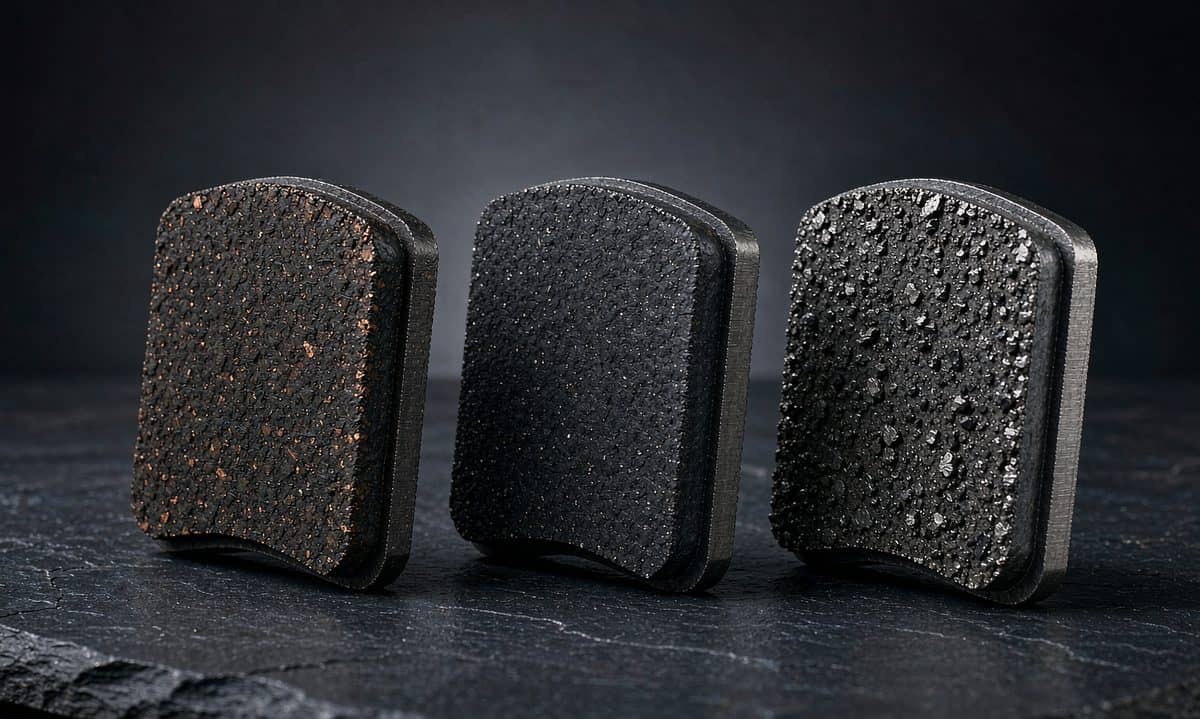
Organic pads use resin-bonded fibres and fillers with little or no metal. They engage gently, run quiet, are kind to discs, and cost little. Their limits: heat and fade. Sustained hard braking overheats an organic compound quickly, and wet performance is mediocre. They are the right pad for small-displacement commuters, scooters and city bikes whose brakes rarely exceed modest temperatures. In our range they are also the pad we specify for rear brakes on heavier bikes — rear pads rarely see the heat the front ones do.
Semi-metallic
Semi-metallic pads blend 30–65% metal content with organic bonding. They handle more heat, last longer, bite harder than organic — and they are harder on discs and noisier, especially cold. This is the volume sweet spot for the aftermarket: a good semi-metallic pad suits most commuters, tourers and mid-weight bikes across a broad temperature range. If a distributor stocks exactly one pad line, it is usually this one.
Sintered
Sintered pads are fused metallic powder — effectively a sintered bronze friction surface bonded to a backplate. They deliver the strongest cold bite, the highest temperature tolerance and the best wet performance of the three. Trade-offs: highest cost, highest disc wear, and a break-in period where bite is erratic. They are the correct choice for heavy bikes, mountain riding, sustained rain, and anything that brakes hard repeatedly.
Choosing by duty
| Riding condition | Compound | Rationale |
|---|---|---|
| City commuting, small bikes | Organic | Quiet, gentle, discs last long |
| Mixed use, volume aftermarket | Semi-metallic | Broadest temperature window |
| Heavy bikes, mountains, rain | Sintered | Fade resistance and wet bite |
| Rear pads on heavy bikes | Organic / semi-metallic | Rear sees little heat |
Two practical notes
Compounds and discs are a system. A sintered pad on a thin organic-spec disc wears the disc fast; an organic pad on a hard stainless disc may never develop full bite. When in doubt, match the pad to the disc spec the bike originally shipped with.
Certification matters in some markets. If you distribute into Europe or anywhere enforcing ECE R90, pads must carry approval — an uncertified pad is not a bargain, it is unsellable stock. Our ECE-approved line is marked accordingly, and we can supply the approval numbers per SKU on request.