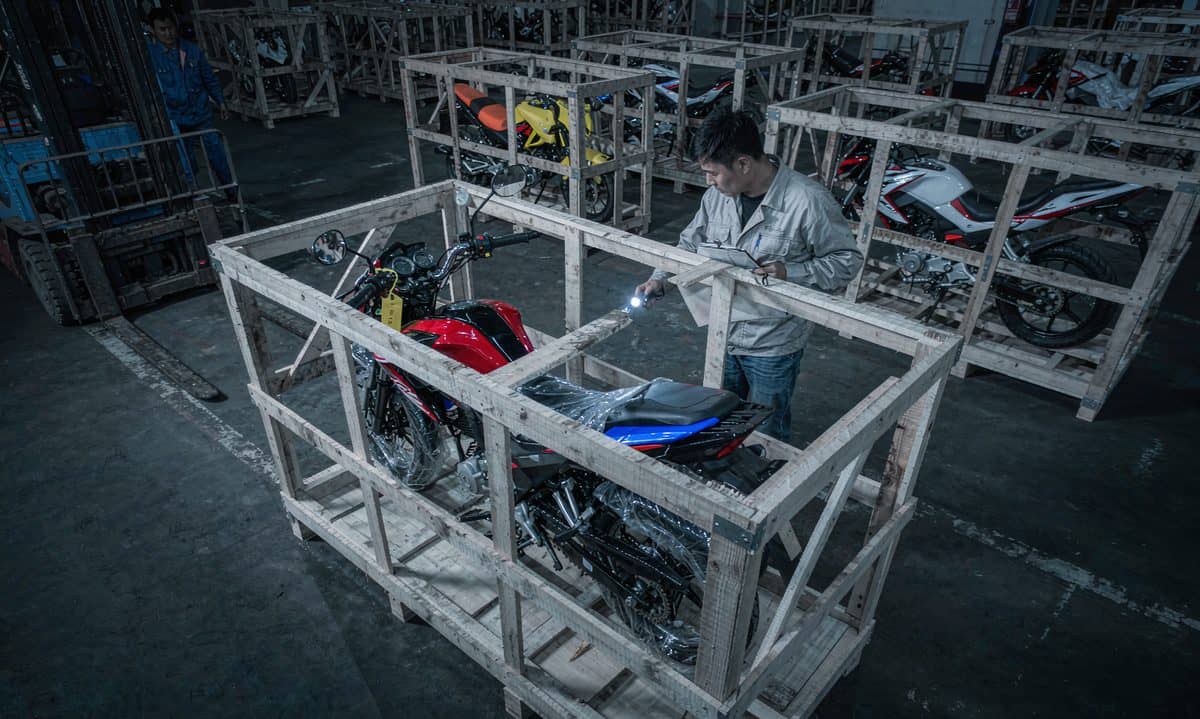
Contrôle avant livraison : la liste de 24 points pour motos importées
MOTOKS Team·16 octobre 2026·MotorcyclesPDIimportquality controlchecklist
Every motorcycle that travels in a crate arrives unfinished — by design. Battery disconnected, fluids drained or minimal, controls loose for packing, tires at shipping pressure. The distance between "crated" and "customer-ready" is the pre-delivery inspection, and skipping points on it is how a new import business earns its first warranty disasters. This is the checklist our own QC line runs; adapt it freely.
Unpacking and frame checks (points 1–6)
- Inspect crate for impact damage before opening — photograph any crush marks; they pre-date your claim.
- Check frame and subframe welds for transit cracks, especially around the steering head and swingarm pivot.
- Verify steering lock-to-lock for full travel and no cable pinch.
- Confirm wheels spin freely with no rim dents from strapping.
- Check all fasteners on the handlebar, levers and mirrors for packing-loose torque.
- Verify VIN/frame/engine numbers match the shipping documents — before anything else.
Fluids, battery and electrics (7–13)
- Fork oil level and seals — transit leaks appear here first.
- Brake fluid level and lever feel; bleed if the lever is soft.
- Engine oil level (some models ship dry or with a partial charge).
- Coolant level on liquid-cooled models, including the overflow.
- Battery: fill/charge, verify voltage (≥12.6V resting) and terminal torque.
- All lights, horn, kill switch and instrument illumination.
- Charging system output at idle (13.5–14.8V typical).
Dynamic checks (14–20)
- Cold start: idle speed, choke/enrichener operation, no abnormal noise.
- Carburetor/EFI: smooth throttle response, no hunting; verify idle mixture within spec.
- Clutch: free play, engagement point, no slip or drag.
- Gearbox: every gear, including finding neutral at a standstill and at a stop.
- Brake test at low speed, front and rear separately; verify no pull or grab.
- Suspension: sag and damping feel on a bounce test.
- Torque-check axle nuts, brake caliper bolts, handlebar clamps — shipping vibration finds under-torqued hardware.
Documentation and handover (21–24)
- Owner's manual and warranty card in the correct market language.
- Registration papers and conformity documents match VIN.
- Spare tool kit and any included accessories present.
- Bed-in instructions handed over — this is the step that prevents most early brake and engine complaints.
The economics of skipping
A PDI costs an hour of skilled labor. A transit-damaged fork seal discovered by the customer costs a claim, a part, a mechanic, and the customer's confidence — usually more than the bike's margin. For dealers, PDI quality is not overhead; it is the cheapest warranty insurance available.