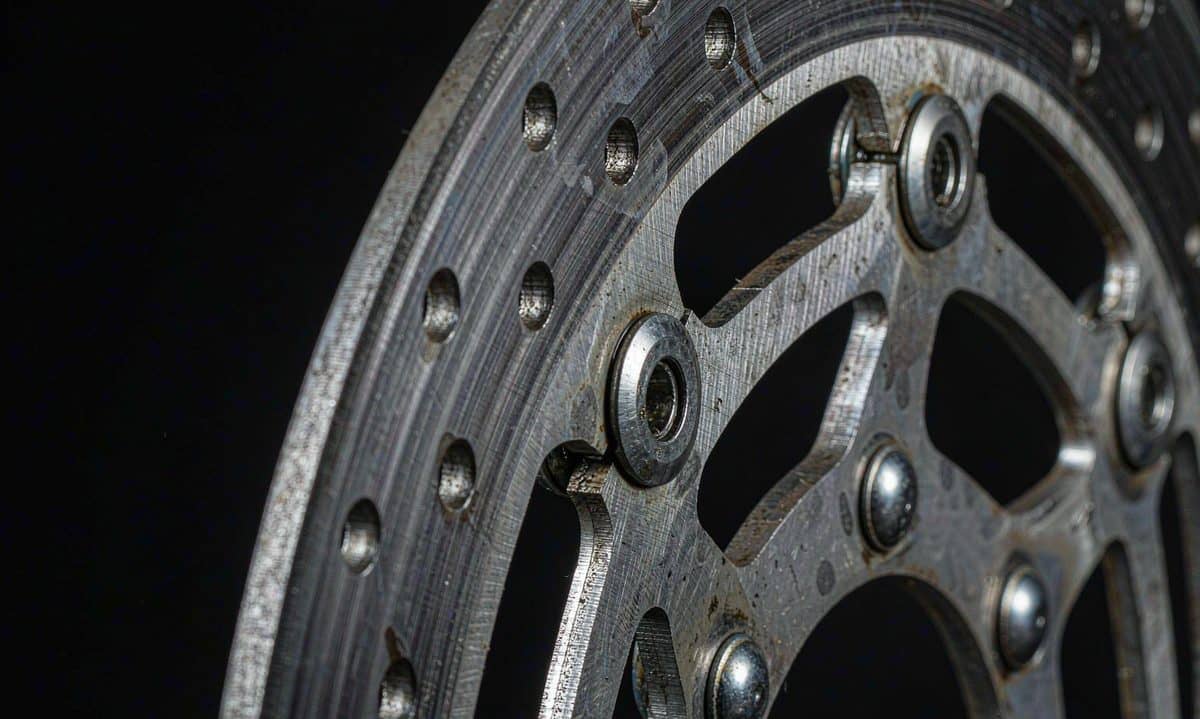
Disques flottants vs fixes : ce que cela change sur la route
A brake disc does two jobs at once: it is a friction surface and a structural wheel of steel that gets hotter than any other rotating part on the bike. The floating design exists because those two jobs fight each other.
The problem with fixed discs
Steel expands when hot. A one-piece rotor bolted rigidly to the hub cannot expand freely, so heat builds internal stress: the disc cones (warps axially) or develops thickness variation. Riders feel this as brake pulsing — and once it appears, the disc is done. Fixed discs work fine on light bikes and moderate use, which is why every small commuter ships with one.
What floating solves
A floating disc splits the rotor into a braking ring and an inner carrier, joined by floating bobbins (rivets with clearance). The ring can expand radially and settle axially as it heats, so thermal stress has somewhere to go. Result: flatness survives hard, repeated braking; thickness variation develops far more slowly; braking stays smooth through a descent that would warp a comparable fixed rotor.
What floating does not do
A floater does not increase friction or stop shorter by itself. And a badly made one is worse than a good fixed disc: loose bobbins rattle, worn bobbins create knock at the lever, and cheap carrier rings can crack at the bobbin holes. The design only pays off with manufacturing quality behind it.
How to judge a floating disc
- Bobbin fit: each bobbin should have slight, uniform float — rotate one by hand. Identical slop on all bobbins is design; one loose and one tight is junk.
- Runout spec: ask for the number. We hold axial runout under 0.15mm on our floating discs; anything above ~0.3mm will be felt at the lever.
- Material pairing: the ring and carrier should be different alloys (typically a harder stainless ring on an alloy carrier). Same-alloy "floaters" are cosmetic.
- Hardware: quality floaters use shouldered bobbins or button kits with proper retainers — not plain rivets.
Recommendation
Commuters and small-displacement bikes: fixed discs, full stop — simpler, cheaper, adequate. Street bikes above ~250cc ridden in mountains, touring machines and anything that brakes hard repeatedly: floating, provided it is a quality unit. If you are specifying for a distributor range, we can supply runout and hardness certs per batch — the two numbers that separate a real floater from a decorative one.