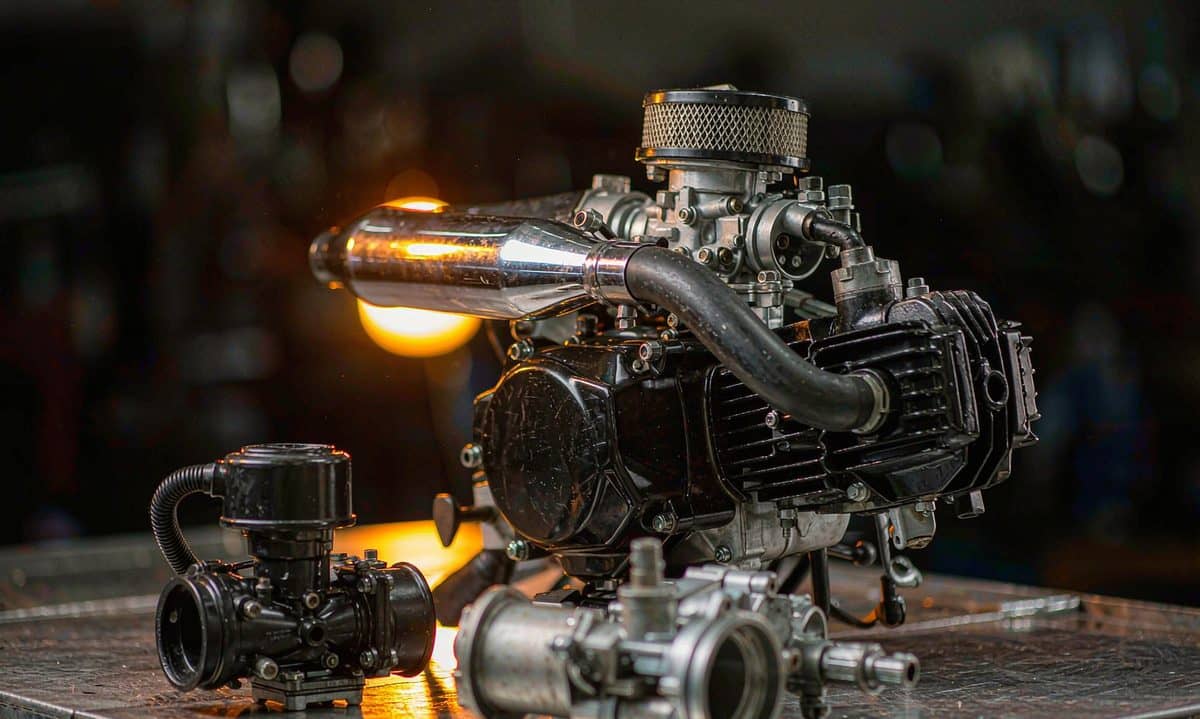
المكربن مقابل الحقن الإلكتروني في السعات الصغيرة
Fuel injection has taken over the motorcycle market — in the segments where regulation pushed it. Step into the 50–250cc world, where most of the planet actually rides, and the carburetor is still very much alive. As a factory that supplies both carburetors and EFI components, we get asked the same question every week: which one makes sense for my bikes? The honest answer depends on four things: unit cost, who services the bike, the market's emission rules, and the riding conditions.
Where the carburetor still wins
Cost per unit. A complete PZ- or PE-series carburetor costs a fraction of an EFI throttle body plus ECU, injectors, oxygen sensor and wiring harness. On a commuter that retails for under $1,000, that difference moves the whole BOM.
Repairability. A carburetor can be rebuilt with a $5 gasket kit, a screwdriver and a 20-minute video. A failed injector, pump or sensor on a small bike usually means replacing the whole assembly, often with a dealer-level diagnostic tool. In markets where the nearest dealer is 200 km away, the carburetor's fixability is not nostalgia — it is infrastructure.
High-altitude and cold-start tolerance. A carburetor recovers from bad fuel, wrong battery voltage and sub-zero mornings with nothing more than a choke lever. EFI compensates automatically, but when it fails at 4,000 m in the Andes, there is no roadside fix.
Where fuel injection wins
Emissions. Euro 5, Bharat Stage VI and similar regimes effectively require closed-loop EFI on new homologated motorcycles. If you are building bikes for regulated markets, this decision was made for you.
Consistency across a fleet. EFI self-compensates for altitude, temperature and wear. A carburetor that is perfect in Guangzhou will run lean in Bogotá until someone re-jets it. Fleets that cannot guarantee tune-ups should prefer EFI.
Fuel economy under varying load. Closed-loop injection trims the mixture in real time; a carburetor is always a compromise tuned for one operating window.
The hybrid reality of the aftermarket
Most of our wholesale customers live in a mixed world: new homologated bikes run EFI, while the enormous installed base of older CG, GY6, CBT and YBR platforms keeps carburetor demand steady and predictable. Replacement carburetor volume has been remarkably stable for a decade — engines outlive their original carbs, and the aftermarket does the rest.
Our recommendation, plainly
- Building new bikes for regulated markets: EFI, no debate.
- Building or servicing cost-sensitive bikes for markets with thin service networks: carburetor, with a well-documented jetting range.
- Buying stock for a distribution business: carry both, but weight your carburetor SKUs toward the platforms that actually exist in your market — check your service records, not the brochure.
A carburetor is not old technology; it is appropriate technology for a specific economic environment. If you need help mapping carburetor series to your engine platforms, our engineers spec kits by displacement, intake bore and operating altitude — send us the engine list and we will return a recommended range.