لماذا يتجمد المكربن شتاءً وكيف تعالجه
Carburetor icing is one of those faults that sounds like a myth until you meet it. The bike runs perfectly in the garage, stumbles after five minutes of steady light-throttle riding, clears when you stop — then does it again. In humid weather between roughly 2°C and 12°C, this is usually ice, not fuel.
The physics in one paragraph
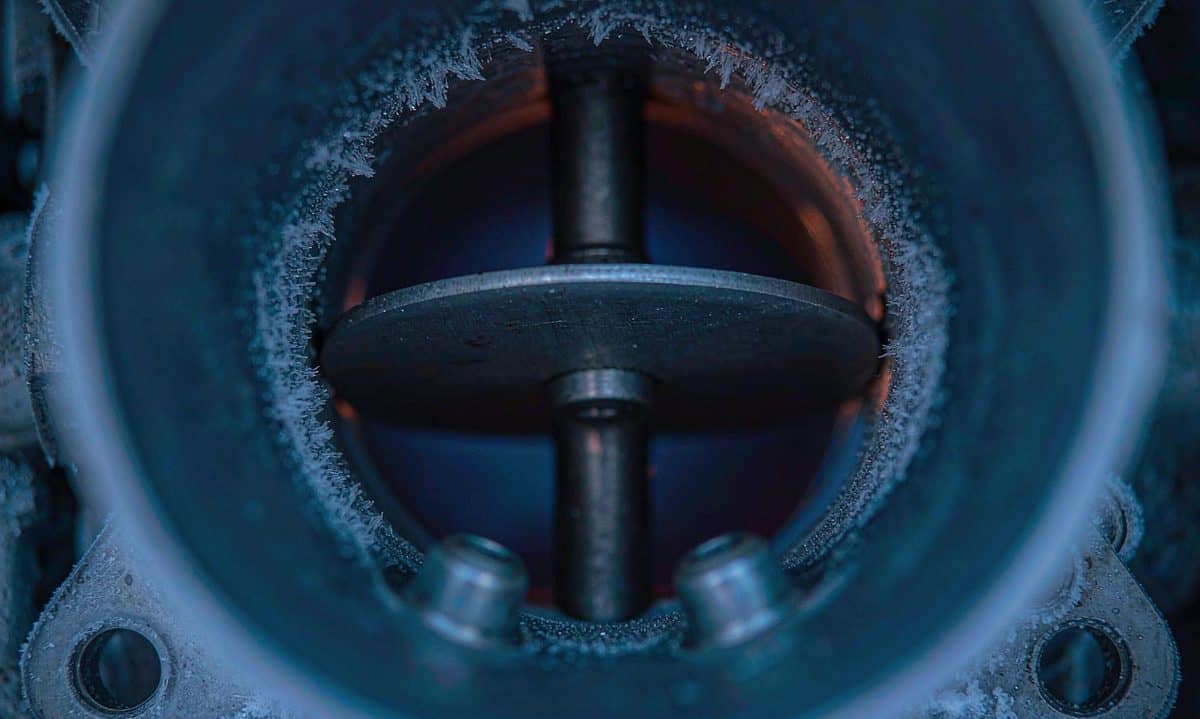
Fuel evaporating in the venturi drops the local temperature dramatically — evaporative cooling can pull the air-fuel region 20–25°C below ambient. Add humid air, and water vapour freezes onto the coldest surfaces: the butterfly valve, the low-pressure region just downstream of it, and sometimes the venturi wall. The ice gradually blocks airflow at exactly the point that meters it, so the engine leans out and stumbles even though the jets are perfect.
The danger zone
The risk peaks when ambient temperature is low but humidity is high — a damp 5°C morning is the classic case. Dry cold (a sunny −5°C day) is often safer than a wet 8°C day, because there is less water vapour available to freeze. Riding in rain near freezing is the highest-risk combination of all.
Recognising it
- Symptoms appear after 5–15 minutes of steady, light-to-medium throttle riding.
- The engine recovers fully after a few minutes at rest, then fails again the same way.
- Opening the choke partially richens the mixture and often restores power — a strong hint that airflow, not fuel supply, is the problem.
- Jetting changes do nothing. If you have re-jeted twice and the symptom is unchanged, stop and think ice.
Fixes, in order of practicality
- Heat shielding and warm-air intake. Many OEMs route a duct from the exhaust shroud or cylinder head to the airbox for exactly this reason. If your market has cold, humid winters, a warm-air intake tube is a legitimate accessory, not a hack.
- Insulate the carburetor. Aftermarket insulating wraps and intake spacers reduce heat loss from the engine to the carb body — cheap, and effective for mild cases.
- Alcohol-blended fuel. Fuel with a few percent ethanol freezes at a much lower temperature and absorbs some water; in ice-prone regions it genuinely helps.
- Anti-icing additives. Isopropyl-based fuel line antifreeze works for fleets that must run through winter — specify it in your rider documentation.
For distributors in cold-humid markets, it is worth stocking the warm-air duct and the insulating spacer as companion SKUs to your carburetor range. The part costs little; the customer who discovers the fix in your shop comes back for everything else.