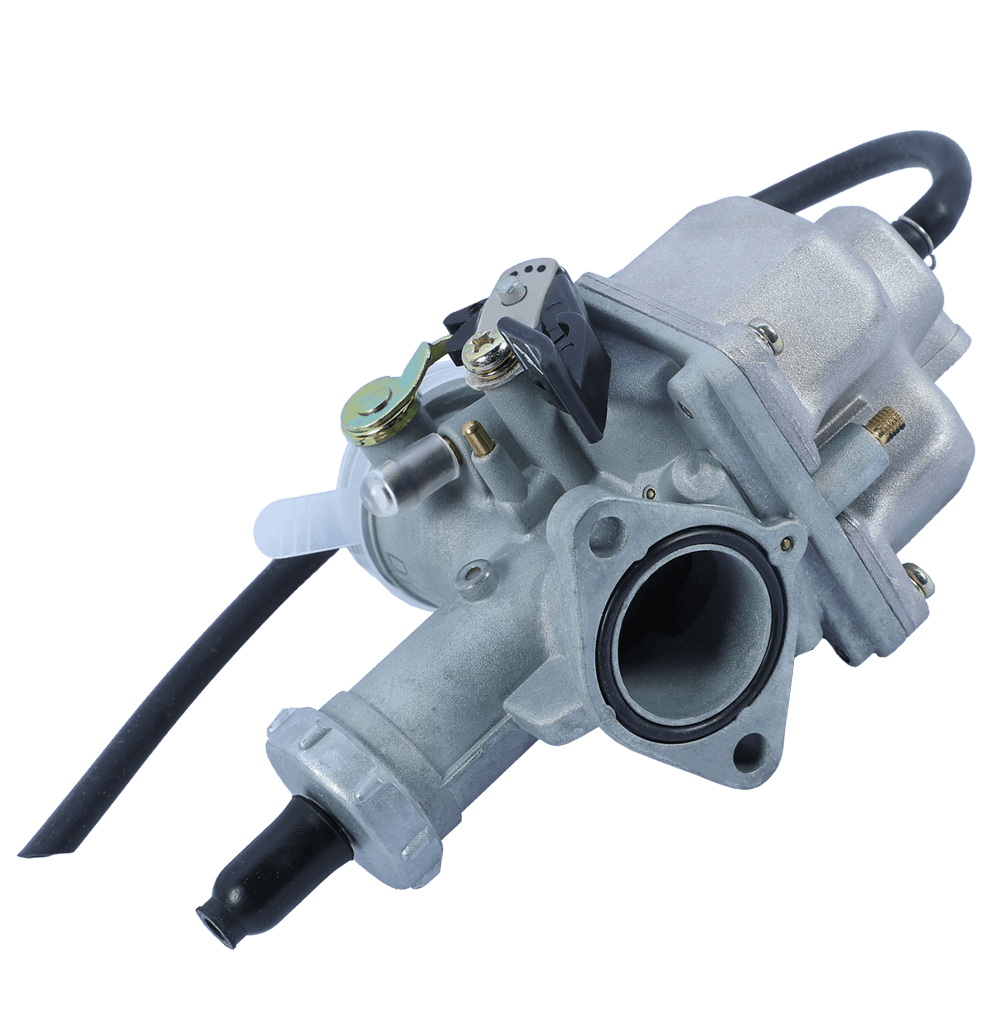
Как подобрать размер карбюратора для двигателя 125-250 см3
Carburettor sizing is one of the most frequently misunderstood specifications in the aftermarket. A larger carburettor does not automatically make more power — it moves the power band upward and, past a point, reduces output everywhere.
What venturi size actually controls
The venturi creates the pressure drop that draws fuel into the air stream. A larger venturi flows more air at wide-open throttle, but it also produces a weaker signal at low airflow. That weaker signal is why an oversized carburettor feels flat and hesitant at small throttle openings, and why it needs richer jetting to compensate.
So the question is not "how much flow can this engine use" but "at what rpm does this engine need to breathe most".
A working rule for 125–250cc singles
- 125–150cc, stock or lightly modified: 26 mm is the usual choice. Going to 28 mm on a stock engine typically loses low-end response and gains nothing measurable at the top.
- 150–200cc, mild tuning (cam, exhaust, port cleanup): 28 mm suits most builds. This is the size where the trade-off between response and top-end flow is closest to neutral.
- 200–250cc, or a 150–200cc with head work: 30 mm becomes viable, but only with a free-flowing intake and exhaust. Bolting a 30 mm carburettor onto a restricted engine produces a bike that is worse everywhere.
- Above 250cc: consider a flat-slide design, and expect to spend time on jetting rather than on bolting it on.
The symptoms of getting it wrong
Too large: hesitation when opening the throttle from low rpm, a flat spot that jetting cannot fully remove, poor fuel economy, and a plug that reads lean even though the main jet is already oversized. The engine also tends to need a higher idle to stay running.
Too small: strong low-end response but the engine runs out of breath early, the top-end feels strangled, and exhaust gas temperature climbs at sustained high load. Riders often describe this as "it pulls well but stops pulling".
Jetting after you choose the size
Once the venturi size is fixed, jetting is a separate exercise, and it must be done at the altitude the bike will actually be used at. A carburettor calibrated at sea level and ridden at 2,500 m will be rich by roughly two main jet sizes, which is enough to foul plugs and cost fuel economy without producing an obvious symptom the owner will recognise.
Our altitude jet kit exists for exactly this reason. Where a market sits consistently above 1,200 m, it is usually cheaper to order a market-specific calibration than to correct it locally.
A note on "bolt-on" claims
Any carburettor sold as a direct bolt-on for a specific model is a compromise: it is jetted for a generic engine in generic conditions. It will run. It will not be optimal, and the difference is usually worth two or three jet changes to any customer who rides more than short distances.
Комментарии (0)
Комментариев пока нет. Будьте первым!