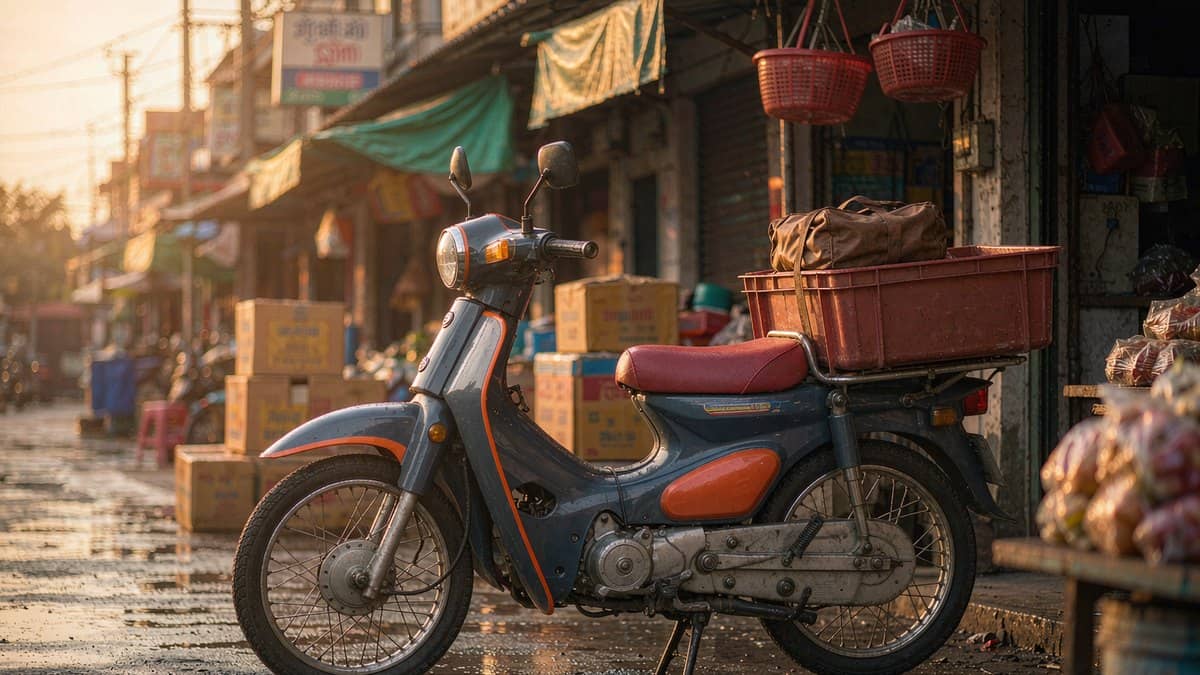
Honda Wave 125 Alpha: The Parts Stocking Guide for Southeast Asia's Commuter Backbone
The Honda Wave 125 Alpha is the default motorcycle of daily life across mainland Southeast Asia: school runs in Cambodia, market deliveries in Vietnam, rice-farm transport in Thailand, tricycle base in the Philippines. It inherits the Wave/Alpha family architecture — an underbone frame with a 125cc air-cooled engine and manual four-speed clutch — and its parts demand reflects a specific truth about the region: these bikes are ridden constantly, maintained lightly, and kept running forever. The platform rewards distributors who stock the quiet, steady rotation of wear parts rather than the dramatic failure lines.
How the Wave Differs from CG-Style Platforms
Distributors familiar with the CG family should recalibrate for the Wave. Three structural differences shape the assortment:
- Underbone frame, smaller wheels. 17-inch spoked or cast wheels, lighter brakes, and body plastics that crack in tips — the plastics and footrest line matters far more than on a CG.
- Drum brakes front and rear on most Alpha variants (a front disc appears on some trims). Brake shoes, not pads, are the core braking SKU.
- Lighter duty cycle, higher operating hours. Less cargo than an African working bike, but near-daily use in rain and traffic: electrics, bearings and chain maintenance dominate.
Our regional market guide contrasts this demand profile with the African working-bike pattern; the parts maps differ more than the engine displacements suggest.
The Wear-Parts Map
Engine Top End
The 125cc OHC engine (chain-driven camshaft, unlike the CG's pushrods) concentrates demand on: piston and ring sets, valves and guides, and above all the cam chain and tensioner — the Wave's signature wear item, announcing itself with a rattling top end at 20,000–30,000 km. Stock complete tensioners, not just chains; a stretched chain on a tired tensioner is a two-part job. Head and base gasket sets sell with every top-end job, and the cylinder kit market splits between standard rebore and +0.50 oversize depending on the workshop culture of the market.
Carburetor and Fuel
The Wave's carburetor is a compact 22–24mm piston-valve unit specific to the family's cable and choke geometry — stock it by OEM cross-reference rather than by bore, as our OEM cross-reference guide explains. Complete units outsell kits 3:1 in this market too. Air filters are a monthly-consumption item in dusty service, and fuel taps, petcock seals and tank caps round out the fuel line.
Clutch and Drive
Friction plate sets with springs follow the standard commuter pattern (our material guide covers compounds). The chain is 420 pitch on most variants; in flood-prone and coastal markets, quality sealed chains outsell economy chain despite the price gap, because rust and washout kill unsealed chains quickly. Sprocket sets move steadily, with the front sprocket often replaced alone where budgets are tight — carry both together in kit form for the durability-first buyers.
Brakes and Wheels
Drum brake shoes front and rear are the volume braking SKU — the front shoe wears fastest in the Wave's traffic-heavy usage. Wheel bearings and seals (front and rear, plus the steering stem) are a steady line, and the speedometer gear drive on the front wheel is a recurring small failure. Spoked-wheel variants consume spokes and rims; cast-wheel variants shift demand to bearings and the brake panel hardware.
Electrics — Where the Rain Matters
Southeast Asia's rain and humidity make the electrical line disproportionately active compared with drier markets: regulator/rectifiers, CDI units, ignition coils, starter motors and solenoids, horn and lighting assemblies, and wiring harness sections all move steadily. Quality tolerance is unforgiving here — a failed regulator cooks the battery and the customer blames whoever sold the last part. Our vetting checklist treats batch consistency as the core factory signal for exactly this reason.
Body and Consumables
The underbone's plastics line is real demand, not an afterthought: side covers, tail panels, footrest sets, chain guards and mirrors are the tip-over consumables, and on delivery bikes they are replaced several times over the bike's life. Add cables (throttle, clutch, brake — humidity makes them stiff and sticky), lever sets, and the oil and air filter consumables, and the Wave's low-value/high-frequency tier is complete.
The Tricycle Effect
In the Philippines and parts of Cambodia, the Wave 125 is not just a motorcycle — it is the base of a tricycle: a sidecar welded to the frame carrying passengers or cargo daily. The tricycle duty cycle changes the platform's demand in specific, predictable ways. Rear shock absorbers and swingarm bearings wear at multiples of solo rates; the 420 chain and rear sprocket consume faster under sidecar load; and the left-side footrest, axle and wheel hardware see constant stress from the attachment. Shops serving tricycle fleets buy heavier-duty shocks and chains than the solo market, and they know the difference — price-tier the line accordingly. Engines under sidecar load also run hotter, which pulls clutch and top-end demand forward. A Wave 125 assortment that ignores the tricycle segment serves half of certain markets; one that stocks for it becomes the default source for the highest-volume operators.
Rainy Season Is Electric Season
Time the electrical line to the monsoon calendar. Regulator/rectifier failures, corroded connectors, failed starters and soaked CDI units cluster in the weeks after the first sustained rains, as water finds every marginal seal. Workshops that know the pattern stock regulators and connectors ahead of the season; distributors should ship the seasonal push one month earlier — electrical bundles, wiring loom sections, contact cleaner and grease packets — alongside the chain and brake consumables that the same service visits generate. The same logic applies to bearings: riding through flooded streets cuts wheel-bearing life sharply, and the post-flood weeks are the reliable demand peak for bearing and seal sets. In this market the calendar is a forecast more accurate than any sales model.
Stocking Nuances for the Wave Market
- Serve the semi-rural parts shop. Wave demand flows through thousands of small-town shops; parts that ship in small mixed cartons and fit right first time win the channel.
- Weather-proof the assortment. Sealed chains, quality electrics and rust-resistant hardware are not upsells in this region — they are the baseline expectation.
- Watch the trim variants. The Alpha family spans disc/drum fronts, spoke/cast wheels and kick/electric start across years. Key SKUs to the variant, not the family name; the fitment errors in this line come almost entirely from trim confusion.
Our brake, carburetor and clutch ranges carry the Wave's core rotation with per-SKU fitment data, and the import logistics guide covers the mixed-container planning that serves a small-ticket, high-SKU-count line like this one efficiently.