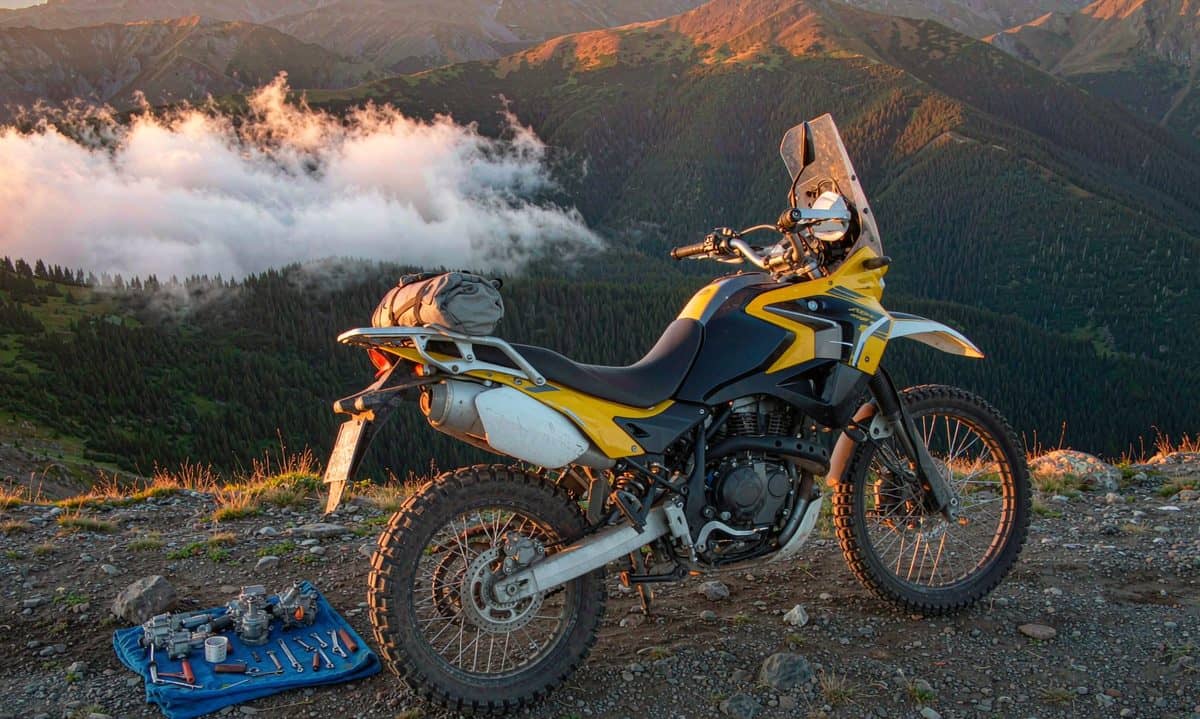
Настройка карбюратора на высоте свыше 2000 м
A carburetor meters fuel by volume and air by volume, so as air gets thinner the mixture gets richer — every time, predictably. Above 2,000 m a sea-level jetting spec is meaningfully rich; above 3,500 m it can foul plugs and wash cylinders. If your market includes highlands — the Andes, the Ethiopian plateau, parts of Central Asia — altitude documentation is part of the product, not an afterthought.
The rules of thumb
- Air density drops roughly 3% for every 300 m of elevation gain.
- Main jet flow must fall by approximately the same proportion. Practical starting point: drop one main jet size per 600–900 m, depending on how aggressive your baseline was.
- Pilot circuits need less correction (they operate at small throttle openings where mixture is dominated by fuel, not air), but a very lean-corrected main with a stock pilot will feel flat off idle.
A worked example
A CG150 tuned at sea level with a #102 main jet goes to 2,400 m. Density loss ≈ 24%. Jet flow scales roughly with the square of jet diameter, so a 20–25% flow reduction needs about 12% smaller diameter — from #102 to roughly #95–96. You would not guess that from the jet rack; you need the table or the calculator. This is exactly the kind of chart we ship with our high-altitude carburetor kits.
Procedure for a fleet
- Establish the sea-level baseline: fresh plug, correct heat range, verified with a plug chop at wide-open throttle.
- Calculate the theoretical correction for your operating altitude.
- Start one jet size richer than theory — you want to approach correct jetting from the rich side, never from the lean side.
- Plug chop, adjust, repeat. Two or three iterations is normal.
- Record the final jetting in the vehicle file: jet numbers, altitude, temperature, plug colour. A fleet without written jetting specs re-learns the same lesson every season.
Needle and pilot at altitude
Raise the needle clip one notch (leaner) for sustained altitudes above ~2,500 m if mid-range feels boggy. Pilot jets rarely change more than one size, and the idle mixture screw usually ends up within a half-turn of its sea-level position.
One warning: do not chase the last 2% of correction. An engine jetted 3–5% rich at altitude runs slightly softer but lives longer than one jetted theoretically perfect and then ridden through a cold front. In thin air, lean side mistakes cost real money.